Walking counts in a busy week
A practical way to fit short walks around commutes, meals and errands in Singapore, without pretending every stroll is a workout.

An open hour for exercise can be hard to find in a working week. A walk is easier to keep when it has a job: getting you to lunch, taking you part of the way home or giving you a break between two tasks. You do not need a new route for each one.
Start with a trip you already make
Look at tomorrow’s calendar and choose one ordinary journey that could include walking. It might be the stretch between an MRT station and your destination, a nearby lunch place, or a supermarket errand. Decide where the walk begins and ends. “I’ll walk more” is easy to forget; “I’ll leave the train one stop earlier if the route is comfortable” is a decision you can actually make.
Keep the first version small enough that a late meeting will not ruin it. If you are carrying groceries, travelling with someone or short on time, take the direct route. The point is to find a repeatable opening, not to make every journey longer.
Use three kinds of opening
You can spread movement across the week without making each walk a separate event:
- On the way: walk a practical part of a commute or errand when the pavement, crossing and weather make sense.
- Between tasks: take a short loop near home or work before sitting down again. Return to a familiar entrance so the break does not become a navigation exercise.
- With someone: suggest a walk after a meal or while catching up, and agree on a pace that lets both of you talk.
Pick one of these for the next two days. If it works, keep it. Add another only when it fits. This is more useful than drawing up a seven-day schedule that depends on everything running exactly on time.
Know what your walk is doing
Singapore’s Physical Activity Guidelines encourage adults aged 18 to 64 to accumulate 150 to 300 minutes of moderate-intensity aerobic activity across a week. The activity can come in periods of any duration. They also encourage light activity to break up long periods of sitting and muscle-strengthening work on at least two days a week.
A gentle walk still gets you moving, but do not automatically count every minute of it as moderate-intensity exercise. Pace matters. HealthHub’s guide describes moderate effort as a pace where you can speak in short sentences but cannot sing. Brisk walking can fit that description; an easy amble may not. If you have been inactive, begin at a comfortable pace and build gradually. If you have a chronic condition and are unsure how to start, the guidelines advise consulting a health professional.
Make the next walk easy to repeat
Keep a pair of comfortable shoes where you will need them, or choose a route that works in what you already wear. Before stepping out, check the conditions rather than assuming the usual path will feel the same every day. Our five-minute outdoor check covers heat, rain and air quality; choose a sheltered or indoor option when an outdoor walk does not suit the day.
At the end of the week, ask a practical question: Which walk happened without much negotiation? Keep that one as your default. If none did, shorten the journey or attach it to a different errand. A useful walking habit should make an ordinary week easier to move through, not become another appointment you keep missing.
Sources
- Health Promotion Board: Singapore Physical Activity Guidelines
- HealthHub: How much exercise is enough for a healthier you
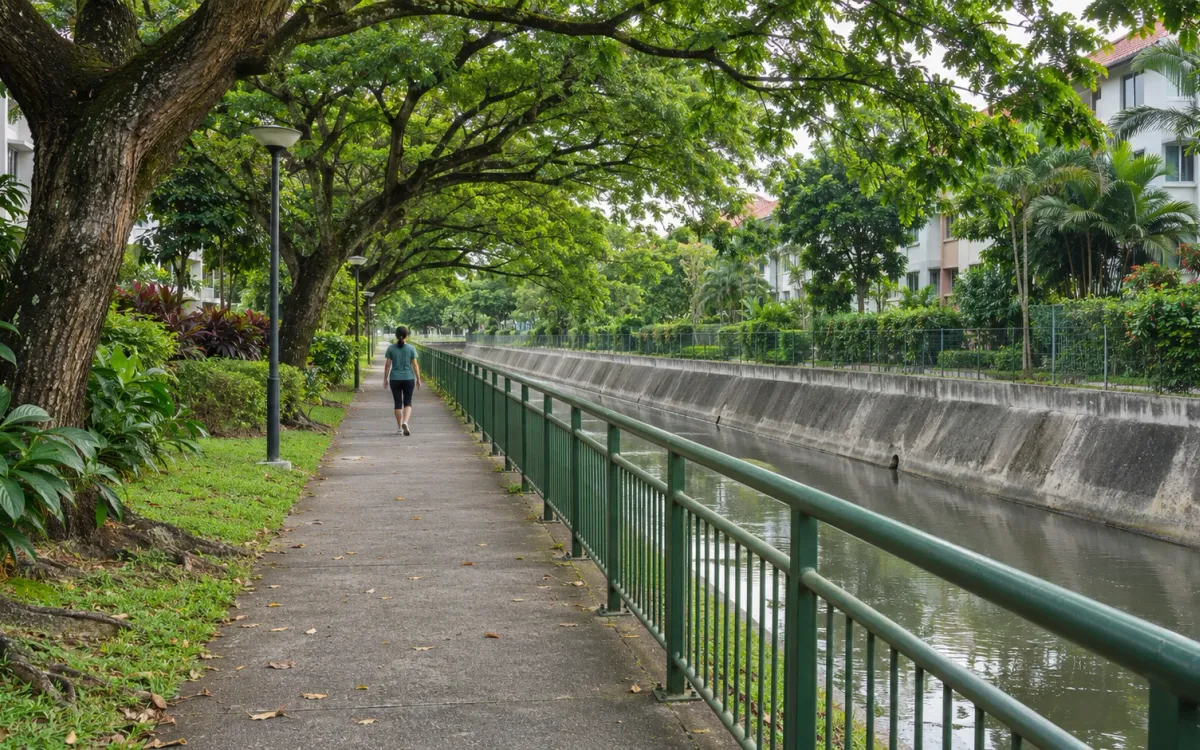
Sources checked on 14 October 2026. This is general information, not an individual exercise prescription. The accompanying image is an AI-generated editorial illustration, not a photograph of a specific path.
Related posts

Your first nature walk in Singapore: start with one trail
Plan a first self-guided nature walk with a clear return, light packing and nature-area rules. Includes Hindhede’s current boardwalk entrance advice.
Siglap Park Connector: plan the walk towards Bedok
Understand what Siglap Park Connector links, the bridge without a ramp, current C4 approach works and why the reservoir circuit is a separate plan.

Punggol Waterway at your own pace: plan a shorter walk
Make a manageable Punggol Waterway outing with a clear arrival point, one place to explore and a return plan that fits the time you have.