Haze and outdoor exercise in Singapore: which reading matters?
Use Singapore's 1-hour PM2.5 reading for a run or walk soon, and the 24-hour PSI forecast for tomorrow. Understand the official activity advice before you head out.
If you are deciding whether to run or walk outdoors soon, check the latest 1-hour PM2.5 reading and its activity guide on NEA’s haze site. For an outing tomorrow, use the 24-hour PSI forecast and health advisory instead. They answer different questions; a number seen last night is not a decision about the air this morning.
Our five-minute outdoor check covers heat, lightning and route access as well. This guide takes a closer look at haze, where the choice also depends on your health and how hard and long you plan to exercise.
For a run soon, use the 1-hour PM2.5 band
NEA’s outdoor-activity guide (PDF) uses 1-hour PM2.5 to describe current air quality and advises checking the latest reading before an activity in the next few hours. Look at the band and its advice, not just the number. The reading is a concentration in micrograms per cubic metre; it is not a PSI score.
At Band 1 (normal), the guide says normal activities may continue. At Band 2 (elevated), it says to reduce strenuous outdoor activity for the next hour. For vulnerable people, the Band 2 advice is to avoid strenuous outdoor activity for that hour. A hard interval session and an easy, brief walk are different plans; this is a reason to reconsider the effort, not to search for a single “safe running number”.
At Band 3 (high), the guide says to avoid strenuous outdoor activity for the next hour; vulnerable people should avoid all outdoor activity for that hour. At Band 4 (very high), everyone should minimise outdoor activity for the next hour and vulnerable people should avoid it. NEA lists older people, pregnant women, children, and people with chronic lung or heart disease as vulnerable in this guide. Follow the current NEA guide if its advice changes.
For tomorrow, check the 24-hour PSI forecast
The 24-hour PSI forecast and corresponding health advisory are for planning next-day activities. NEA says this forecast is available during haze season. Its advice distinguishes healthy people, older people, pregnant women and children, and people with chronic lung or heart disease. The forecast is a planning tool, so check current conditions again shortly before leaving.
For example, in the unhealthy PSI range, NEA advises healthy people to reduce prolonged or strenuous outdoor physical exertion. It advises older people, pregnant women and children to minimise such exertion, and people with chronic lung or heart disease to avoid it. “Prolonged” means several hours of continuous exposure in the guide; “strenuous” means activity involving a lot of energy or effort. Do not apply those PSI categories to the 1-hour PM2.5 number: each reading has its own scale and advice.
Make the decision for the outing you actually planned
First, open the latest official reading rather than judging air quality from the view outside. Then compare the activity advice with your plan: a short local walk, a steady run and a long hard session differ in duration and exertion. If the advice calls for less or no outdoor exertion, changing to an indoor session, postponing, or dropping the workout is a sensible response. You can keep a shorter route close to home when the guidance allows an outing but conditions may change.
Keep checking if you will be outside for a while. NEA advises monitoring the 1-hour PM2.5 reading for activities planned within the same day and checking again before proceeding. If you feel unwell, stop the activity and seek medical attention; the NEA haze guidance says the effect of haze depends on health status as well as exposure and exertion. If you have a chronic heart or lung condition, use your clinician’s advice for your own circumstances. No published band can assess how you feel on a particular day.
Sources
- NEA: How to plan your outdoor activities during haze (PDF)
- NEA: Haze information and air-quality indicators
- NEA: Current haze readings and advisories
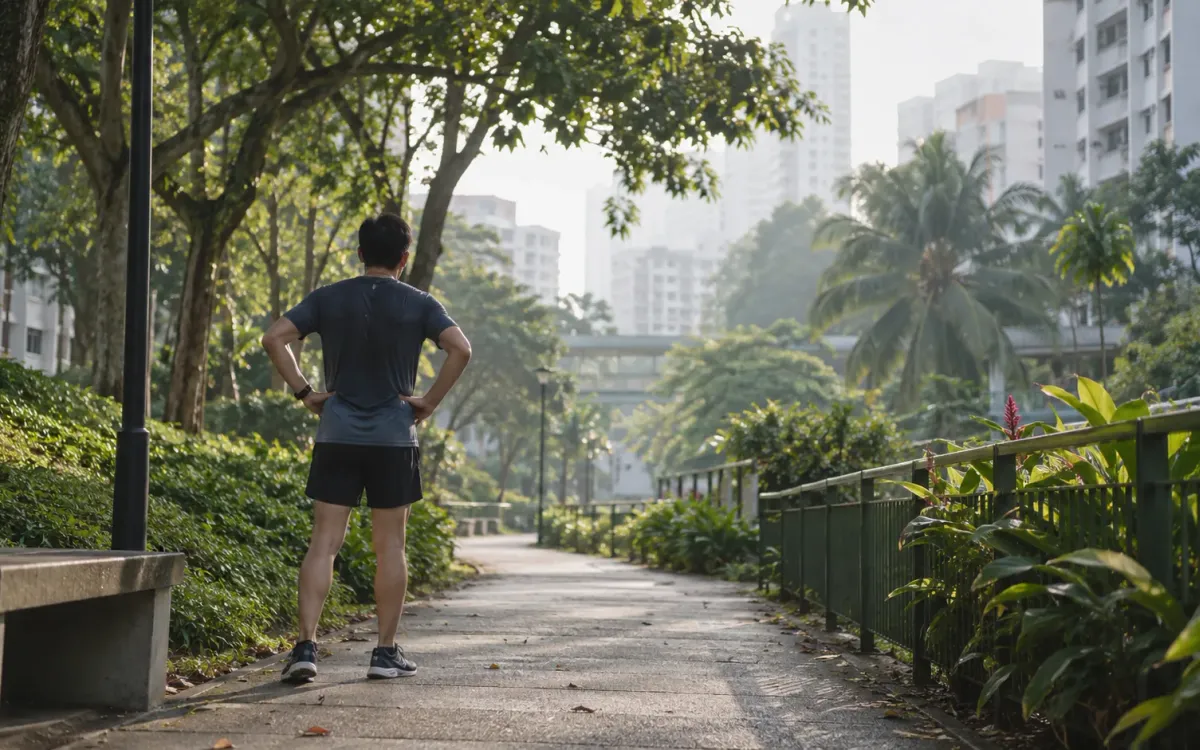
The accompanying image is an AI-generated photorealistic editorial image. It does not show an actual haze event or a measured air-quality condition.
Related posts

Your first nature walk in Singapore: start with one trail
Plan a first self-guided nature walk with a clear return, light packing and nature-area rules. Includes Hindhede’s current boardwalk entrance advice.
Siglap Park Connector: plan the walk towards Bedok
Understand what Siglap Park Connector links, the bridge without a ramp, current C4 approach works and why the reservoir circuit is a separate plan.
An evening walk or run after work, without a late finish
Plan an after-work walk or easy run in Singapore with a clear finish time, a suitable lit route and a way home if conditions change.